Showing posts with label freedom. Show all posts

Thursday, January 08, 2026

Free as a bird?

With the imminent imposition of digital ID and the loss of the right to a jury hearing in some cases, a trend that has been happening all my life seems to be speeding up.  There's also the issue of the police using facial recognition and that fact that the UK is almost a surveillance society (2nd only to China, by some estimates).

So my first question is what freedoms have we lost since WWII?  I asked copilot to tell me.

Here's what it found:

Quick Answer: Since WWII, several rights in the UK have been restricted or removed, often in response to security concerns, industrial relations, or political shifts. Key examples include limits on trade union powers (1970s–1980s), detention without trial under anti-terror laws (2001 onward), curbs on protest rights (2005–2022), and surveillance expansions (2000s–2010s).


📜 Major Rights Removed or Restricted Since WWII

Period Law/Policy Rights Affected Context
1945–1950s Emergency wartime powers continued briefly Freedom of movement & association Post-war rationing and national security concerns
1971 Immigration Act 1971 Right of Commonwealth citizens to settle freely Ended automatic settlement rights for many Commonwealth migrants
1979–1990s (Thatcher era) Employment Acts (1980, 1982, 1988, 1990) Trade union rights, right to strike Restricted closed shops, secondary picketing, and union political activity
2000 Terrorism Act 2000 Freedom of association & protest Broadened definition of terrorism, allowed banning of organizations
2001 Anti-terrorism, Crime and Security Act Habeas corpus (detention without trial) Allowed indefinite detention of foreign nationals suspected of terrorism
2005 Prevention of Terrorism Act Freedom of movement Introduced “control orders” restricting suspects’ movements without trial
2011 Police Reform and Social Responsibility Act Right to protest near Parliament Restricted demonstrations around Westminster
2016 Investigatory Powers Act (“Snooper’s Charter”) Privacy rights Legalized bulk surveillance and data retention
2022 Police, Crime, Sentencing and Courts Act Right to protest Gave police powers to restrict protests deemed “too noisy” or disruptive

⚖️ Key Themes in Rights Removal

  • Trade Union & Labour Rights: The UK moved from strong collective bargaining after WWII to significant restrictions under Thatcher, reshaping industrial relations.
  • Immigration & Settlement: Commonwealth citizens lost automatic settlement rights in 1971, marking a major rollback of post-imperial freedoms.
  • Anti-Terror Legislation: From 2000 onward, terrorism laws curtailed civil liberties, including detention without trial, control orders, and expanded surveillance.
  • Protest & Assembly: Laws in 2005, 2011, and 2022 progressively narrowed the scope of lawful protest, especially near Parliament and in public spaces.
  • Privacy & Surveillance: The Investigatory Powers Act entrenched state surveillance, reducing individual privacy protections. 

🧭 Contextual Notes

  • Many restrictions were responses to crises: terrorism (IRA, 9/11, London bombings), industrial unrest, or migration pressures.
  • Rights were often balanced against security or order, but critics argue these measures eroded fundamental freedoms.
  • The UK’s reliance on parliamentary sovereignty (no codified constitution) means rights can be curtailed more easily than in countries with entrenched constitutional protections.

In summary: Since WWII, the UK has removed or restricted rights mainly in four areas—labour rights, immigration, protest, and privacy/security—with landmark changes in the 1970s (union restrictions), 2000s (anti-terror laws), and 2010s–2020s (protest and surveillance powers).

Sunday, March 22, 2009

Street View / Praying and Caring

Street View
I woke to the news this morning that google has been force to remove some of the views from its street view system. Apparently taking pictures randomly and posting them on the web is an invasion of privacy. I can understand that some people don't like it - especially when it's them, for example:
"Google said it had removed several pictures, including ones that users found embarrassing, such as one of a man leaving a sex shop in central London's Soho neighbourhood, or another one of a man vomiting outside a pub in the east of the British capital."
The BBC chose to mention naked children playing in a garden as something else that was removed.
I can understand that people don't like their photo's randomly published on peoples web sites - people ate church have asked me if its legal, as they wanted to stop it - I don't know the answer - I always recommend that they talk to the people who own the pictures and ask that they are not 'published'. If a magazine takes your picture in a crowd, or coming out of a sex shop, can it publish that image - I expect it can, unless you say otherwise.

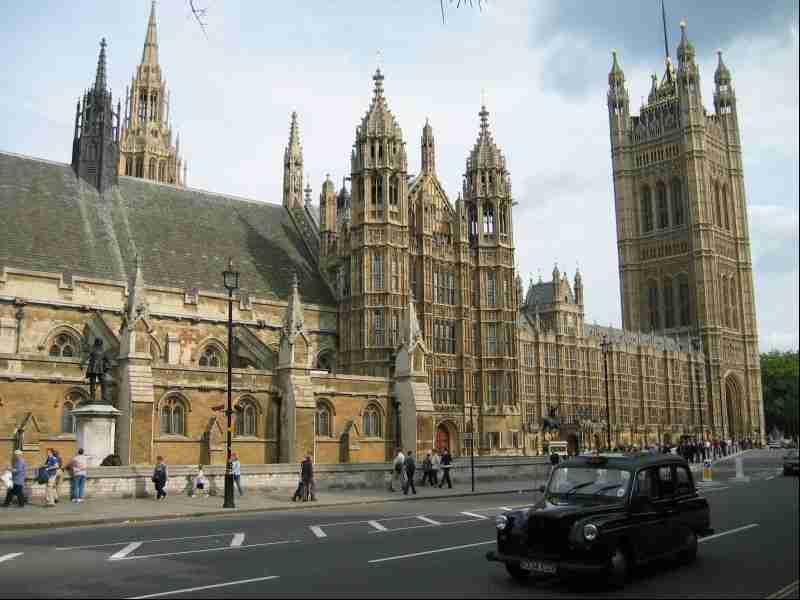
The tired old reason for this was of course security. So google have apparently also removed No. 10 Downing Street, and the Houses of Parliament. No. 10 is known as the most famous door in England and is seen everywhere. Follow the link, you may want to save some of these before the UK government has them removed! Interestingly there are very few pictures of the Houses of Parliament from the road, most are from the river. I deduce that terrorist don't use boats.

It is all about fear, today we are SO fearful of terrorist, paedophiles, and strangers that we have to have everything photographed on CCTV, but never published. Anything that is photographed cannot be published. Anyone who takes pictures is obviously up to no good. There have been stories of tourists being arrested for taking pictures in the street, the same is true of train spotters taking pictures of trains.

So any of you who read this on the Facebok import - make sure your pictures are secure, and not public - or aho knows what may happen!

I'm waiting for the Colonel from Monty Python to come on and tell us its all getting too silly.


Praying and Caring

Today's reading was 'They committed themselves to the teaching of the apostles, [and]...life together...' Acts 2:42 in the discussion that followed about committing our selves and following through or just saying "have a nice day" because we have to was the question "Don't you think that person can tell the difference between the company line and somebody who is genuinely concerned for their welfare? Don't you think God knows the difference?"
We saw the difference for ourselves today. John, the retired minister who was such a great help to us at the end of last year is recovering form his serious illness and was in church this morning. When his presence was announced there was a spontaneous round of applause. While the sermon, and the music were both uplifting today - it was that corporate act that spoke to me most about how we show God's love.

Friday, January 28, 2005

Subscribe ...

From
London Institute of Contemporary Christianity's Word of the week:


“…the truth, which lives in us and will be with us for ever. 2 John 2

“What is truth? said jesting Pilate, and did not stay for an answer.” Thus begins Francis Bacon’s celebrated essay On Truth.
...
The word “truth” in the Bible, however, does not refer simply to objective propositions. This is not to say that objective propositions are unimportant. Indeed, John devotes much of the rest of this letter to the importance of sound teaching and the dangers of error. We need to be held firm by the mooring ropes of the great facts of God’s sovereign acts and purposes in creation and redemption.

But John writes that the truth “lives in us and will be with us for ever”. Biblical truth finds its source in the multi-faceted character of God. .....


and that is where freedom is found.

so ....


John 832 Then you will know the truth, and the truth will set you free.